What is Play-Based Learning?
Play. Once upon a time, it was almost universally accepted that children play. In kindergarten, children played. In first grade, I remember the teacher playing a ball bouncing song, and we learned to bounce a playground ball and catch it with two hands. In the classroom.
Now, even in preschool, play can be seen as something that isn’t as important as academics. Once I saw a post where a teacher said, “Great activity during free-choice time!” Children were to put the red stick in the red cup. The blue in the blue cup. How mind numbing is THAT? That’s free-choice? (If you could see me now, I’m shaking my head in frustration.)
Play-based learning is child-driven. Adults provide opportunities and facilitate, but the children ultimately control the play. There is also learning through play, where the adult determines a learning objective, and provides opportunities to learn the concepts through a fun activity.
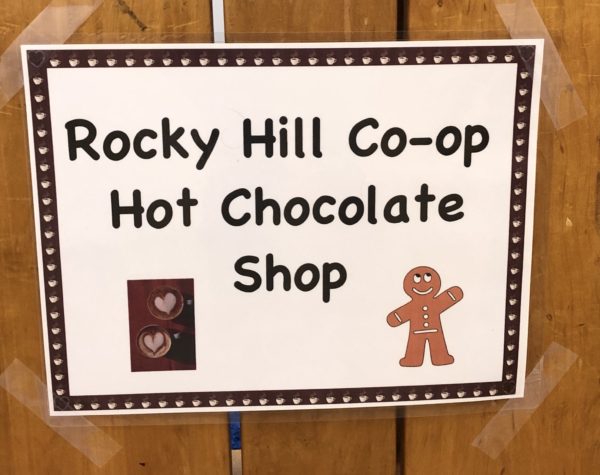
For example: We created a hot chocolate shop in our classroom. We set up what we thought would prompt the children to investigate. We had our pre-conceived notions of what they would do.
A few years ago, I was very puzzled when I saw that children who were “cashiers” would take money from their “customers” and give them their purchases and money! One day my son said to me, “Mom, they’re thinking of debit cards! Cash back!”
Duh!
Children are not as familiar with spending cash as they used to be! When we use play money, many children say, “I have four money,” instead of four dollars.
Small group activities with the teacher can help support their play, and provide many learning objectives at the same time. This is learning through play. I saw that the children needed to learn that there is a direct correlation between money and objects, and determined that the first step should be through an activity that reinforces one to one correspondence.
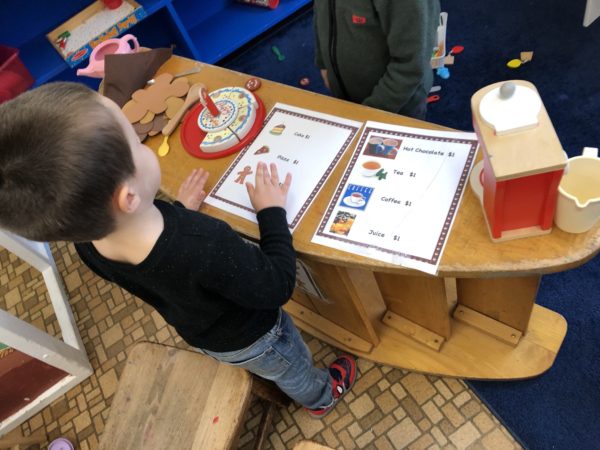
In our Hot Chocolate Shop, we had toy pizza, cake and gingerbread cookies. I printed pictures of these items, and brought over the menus from the shop. Children could order what they wanted by writing how many they wanted in the box next to it, and figure out how much money was needed.
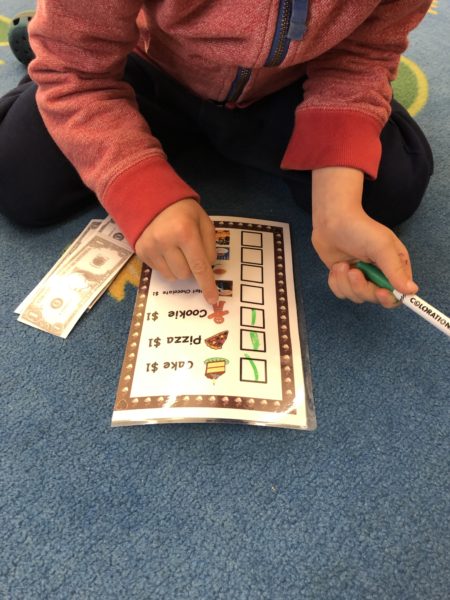
One to one correspondence is a very basic, essential skill for all learning. I’m sure you’ve heard children count to ten, and when shown ten objects, they quickly say “onetwothreefourfivesixseveneightnineten!” They’re not really counting, they’re reciting. Counting involves the understanding that each object is separate.
Developmentally, the sequence would be:
- The child physically picks up and moves an object while counting, moving it from one location to another.
- The child POINTS to each object.
- Pictures can be introduced at this level. Concrete objects must always be used before symbolic ones! The child points to each picture, moving from left to right.
- The child looks at an amount of objects and can tell how many there are without formally counting. (Subitizing)
When counting and reading, children must work from left to right. Below, a child is working from left to right matching one dollar to each picture.
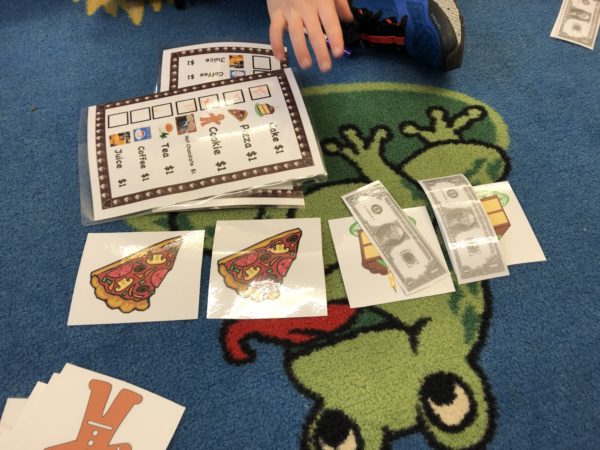
Below, you can see that the child ordered 1 cake, 1 pizza, and 2 gingerbread cookies by writing the numerals. He put them in order from left to right, then matched the dollars appropriately.
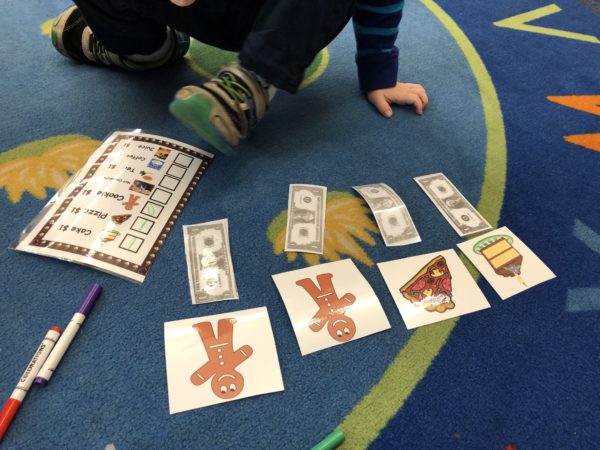
First, the activity was done with adults’ guidance. Then it was taken to the next level, with the children working together, the teacher observing and guiding when necessary.
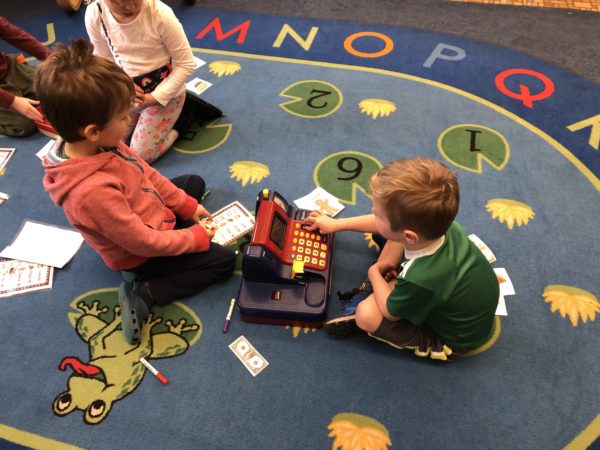
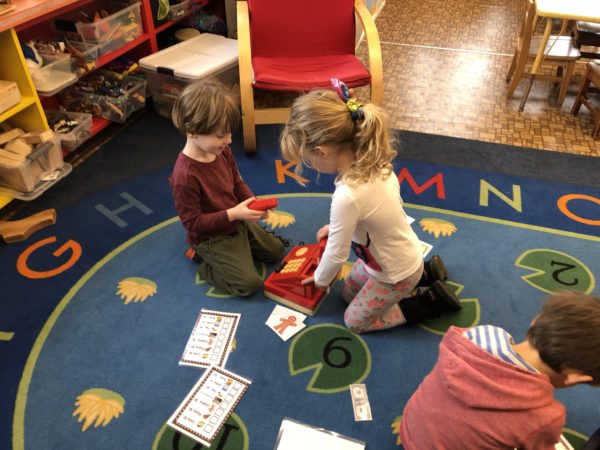
Activities such as this can be a springboard for play based learning. They can take this new information and expand it on their own.
When children direct their own play, adults are there to help facilitate. Basically, we say, “What do you need?”
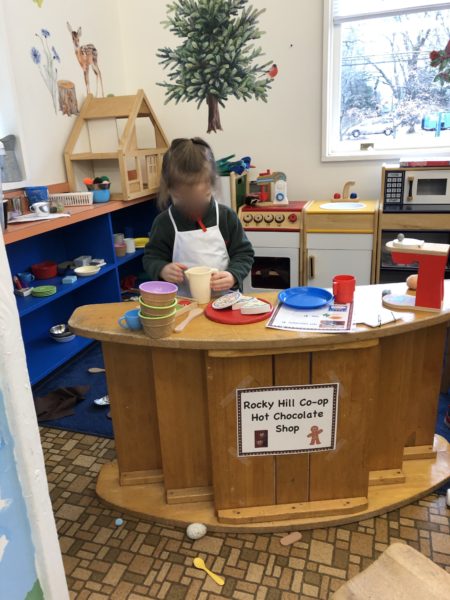
We were told that they needed marshmallows, so we asked what they thought would work, and it was decided that pompoms would be perfect marshmallows, so we got them out of the closet. Then they also become ice cream.
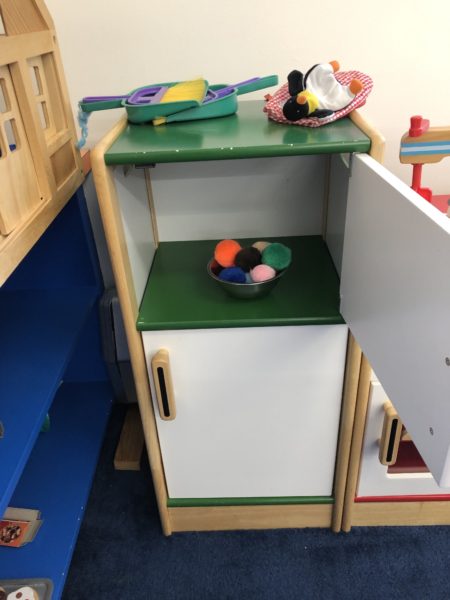
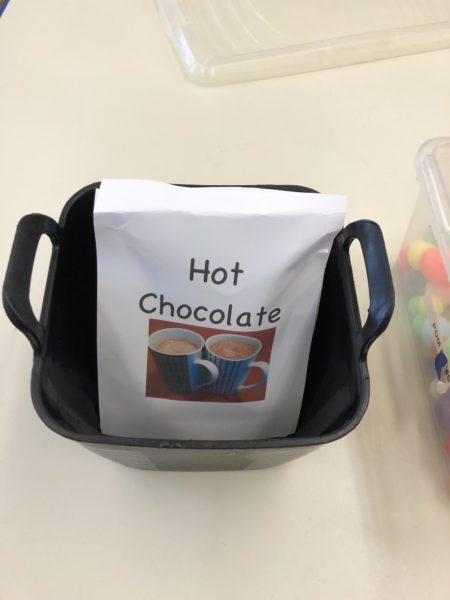
A child decided that they needed hot chocolate packets, so I quickly printed these up. I was told that the packets needed to be filled, so s/he used the pompoms to fill them.
“I want to order food, please.”
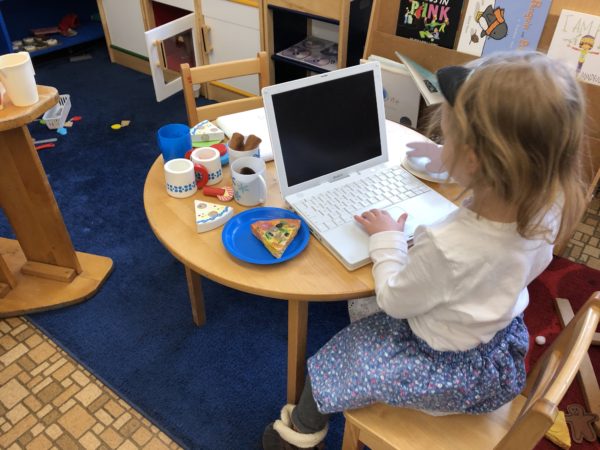
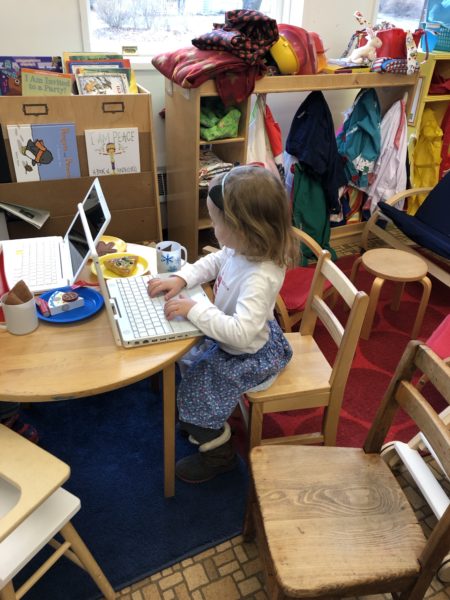
Every cafe needs a place to work on your laptop!
They decided that table service was necessary.
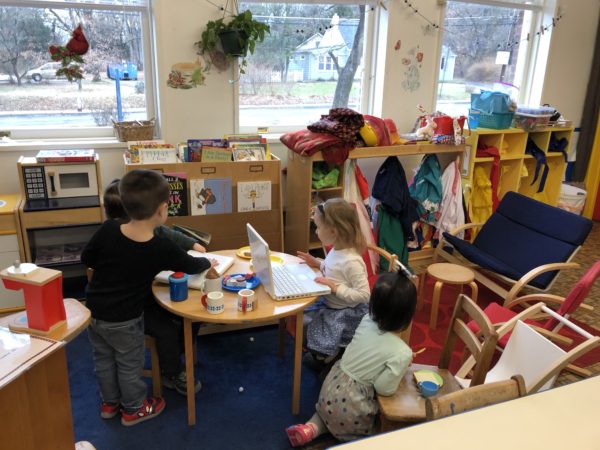
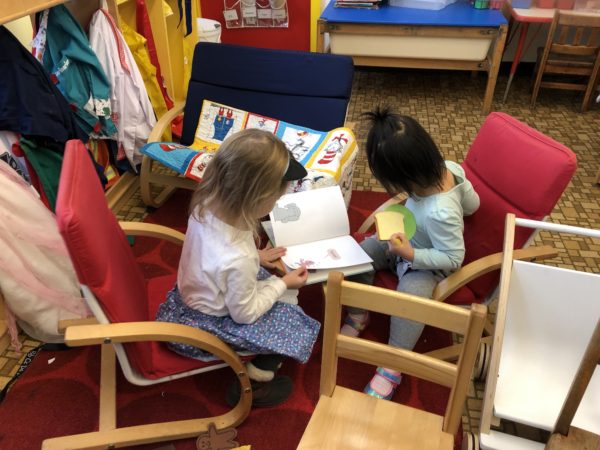
It was decided that the reading area would make a great hotel. Do you see the quilt on the couch? The hotel bed, of course! Every great hotel has a cafe!
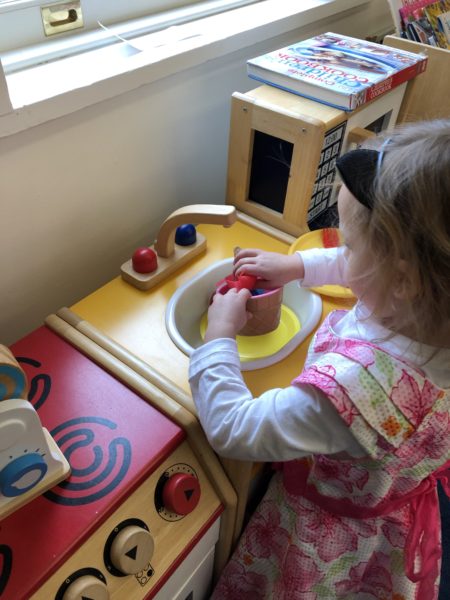
We were told that the dishes must be done!
Besides having fun, developing language skills, negotiating, communicating, working together, counting, etc, children were also working on conflict resolution and executive functioning.
As you can tell, after 13 years of teaching children with special needs, I still think in terms of learning objectives as well as the developmental steps required to achieve these goals. So many objectives are met through play. I may be dancing around and singing with the children as we “shake our sillies out,” but each movement they make is a developmental learning objective. Each stimulates a different part of the brain. You can’t get THAT with a worksheet!